
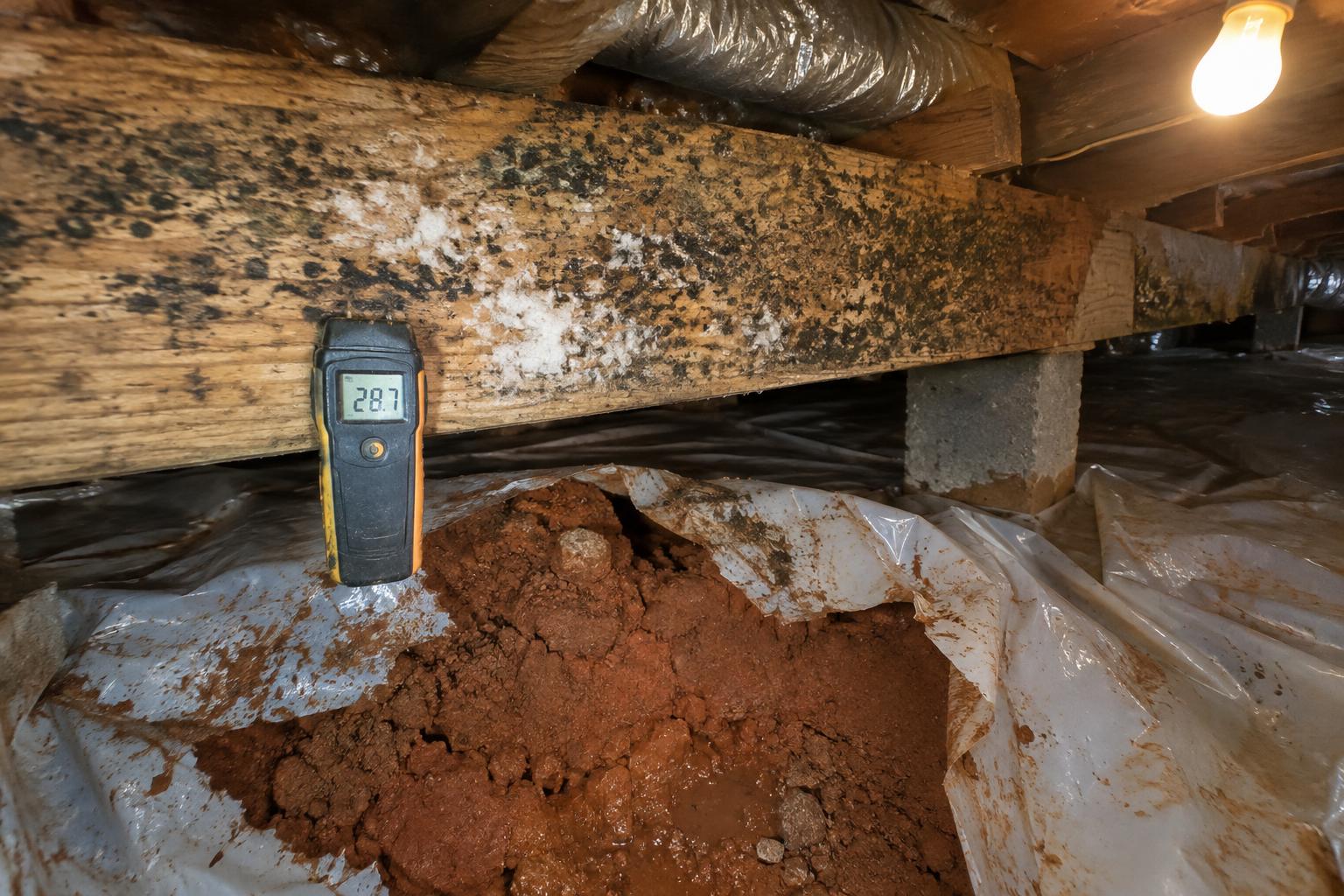
Take a flashlight to your crawl space access door this week and look at the wood just past the opening: the rim joist and the first few floor joists. Dark spotting, a white fuzzy bloom, or wood that gives when you press a screwdriver tip into it tells you moisture has been living under your house long enough to start working on the structure.
That five-minute look says a lot. Many Clinton homes sit over a vented crawl space on red clay, and from June through September the air pulled in through those vents is warm and heavy. When it meets the cooler ground and the underside of your floor, it gives up water. The wood soaks it up slowly. Most people only notice once a floor starts to bounce near the kitchen sink or a musty smell drifts up through the heat registers.
What Clinton's ground does to a crawl space
Clinton sits along the Clinch River with plenty of hillside lots, and the soil under most yards is dense red clay over limestone. Clay holds water and drains slowly. After a long rain, runoff coming down a slope toward your house has nowhere quick to go, so it collects at the lowest point it can reach. Very often that is the dirt floor of the crawl space.
In parts of Anderson County the limestone underneath is karst, full of cracks and hollow pockets. Groundwater can surface in places that seem strange, like the middle of a crawl space far from any wall. Put clay, slope and limestone together with humid summers and you get the common Clinton pattern: puddles that come and go with the weather, a floor that never quite dries, and damp air held in by a thin sheet of old plastic, if there is any plastic at all.
Signs it's time for crawl space repair
Some warnings show up in the living space before anyone crawls under the house:
- Floors that dip, bounce or feel spongy, especially near bathrooms and the kitchen - A musty, earthy smell that gets stronger on humid days - Hardwood boards cupping, or gaps opening along baseboards - Indoor humidity that stays high even with the air conditioning running - More crickets, spiders and other pests than usual
Under the house, look for standing water or mud lines on the piers, joists that sag or have cracked, insulation hanging down in wet clumps, rust on ductwork straps and nails, and fuzzy growth on wood. One of these alone deserves a closer look. Several together usually mean the space needs real work.
How the repair actually goes
Good crawl space repair in Clinton follows an order, because each step depends on the one before it. Reinforcing joists in a space that stays wet only buys time.
**Water comes first.** When water is getting in, it has to be collected and moved out. Depending on the site, that can mean a drain along the low side of the crawl space that carries water to a sump pump, which then sends it outside and away from the house. We also look at where roof runoff lands, since a downspout emptying beside the wall feeds a lot of crawl space puddles on clay lots.
**Structure is next.** With the water source handled, damaged wood gets attention. Sagging beams and joists can be supported with adjustable steel support jacks set on solid footings. Joists that have rotted or split can be sistered with new lumber bolted alongside. The aim is a floor that is level and firm underfoot again.
**Then the air.** Once the space is dry and the framing is sound, it gets sealed. Crawl Space Waterproofing and encapsulation usually mean pulling out wet insulation, laying a heavy vapor barrier across the floor and up the walls, taping the seams, closing the vents, and installing a dehumidifier sized for the space. That keeps humidity in a range where mold has a hard time getting started and wood stays dry through a Tennessee August.
When the crawl space floods
Water standing in the crawl space after a storm is worth a call. Phone 865-503-5483, tell us water is coming in, and we will fit you in as early as we can. While you wait, stay out of the water if it touches wiring, the furnace or any equipment. Take a few photos from the access door and note when the water showed up and how hard it had been raining. That timeline helps us tell surface runoff from groundwater rising through the floor, and the fix for each is different.
What you can check on your own this month
A few simple habits tell you a lot before anyone crawls in:
1. Walk the outside of the house during or right after a heavy rain. Watch where water runs and where it pools against the wall. 2. Put an inexpensive hygrometer just inside the access door and check it weekly through summer. Readings that stay high are a strong sign the space needs sealing. 3. Keep the access door shut and latched so it closes tight. 4. Press on the floor in the rooms above plumbing. Soft spots there often line up with damp joists below.
Write down what you see. Those notes make an inspection faster and more accurate.
Working with Waterproofit TN in Clinton
Waterproofit TN is licensed and insured, focuses on crawl spaces around Knoxville and Anderson County, and backs its work with a workmanship warranty. An inspection means we go under the house, take moisture readings in the wood, photograph what we find, and walk you through the photos. You get a written plan that shows what needs to happen first and why, so you can make decisions with the facts in front of you.
To schedule a crawl space inspection in Clinton, call 865-503-5483.