
Why the next few months matter under Hardin Valley homes
Late spring is when crawl space waterproofing in Hardin Valley pays off the most. The ground is still soaked from spring storms, and the first heavy, humid air of summer is about to pour through the foundation vents. That combination turns a crawl space from damp to wet. The red clay around Hardin Valley holds water long after a rain stops. That moisture has nowhere to go but sideways into the lowest open space it can find. Under a lot of homes, that space is the crawl.
Many houses off Hardin Valley Road and in the subdivisions near Pellissippi Parkway were built with vented crawl spaces on sloped lots. On the uphill side, water drains toward the foundation. On the downhill side, the vents pull in air that can feel close to saturated on a July afternoon. When that warm air meets the cooler dirt and ductwork below the house, it condenses. You end up with sweating pipes, damp insulation hanging from the joists and a musty smell drifting up through the floor registers.
What we usually find in a Hardin Valley crawl space
Every crawl space is a little different, but the patterns repeat. Here is what our crews see most often in this part of west Knox County:
- Standing water near the uphill wall after a storm, sometimes pooling around piers - A thin, torn plastic sheet that covers part of the dirt and traps water on top of it - Fiberglass batts sagging or lying on the ground, heavy with moisture - White or dark fuzzy growth on joists and subfloor, most often near the vents - Soft wood at the sill plate or rim joist where water has wicked in for years - Floors that feel bouncy or slope in one room
The limestone under East Tennessee adds another wrinkle. Karst bedrock is full of cracks and channels, so groundwater can rise in spots you would not expect after a long rain. Two neighboring houses on the same street can have very different crawl spaces for that reason. It is why we look before we price anything.
How crawl space waterproofing works, step by step
The goal is simple. Keep liquid water out, then control the air so the space stays dry year round. The work usually happens in this order.
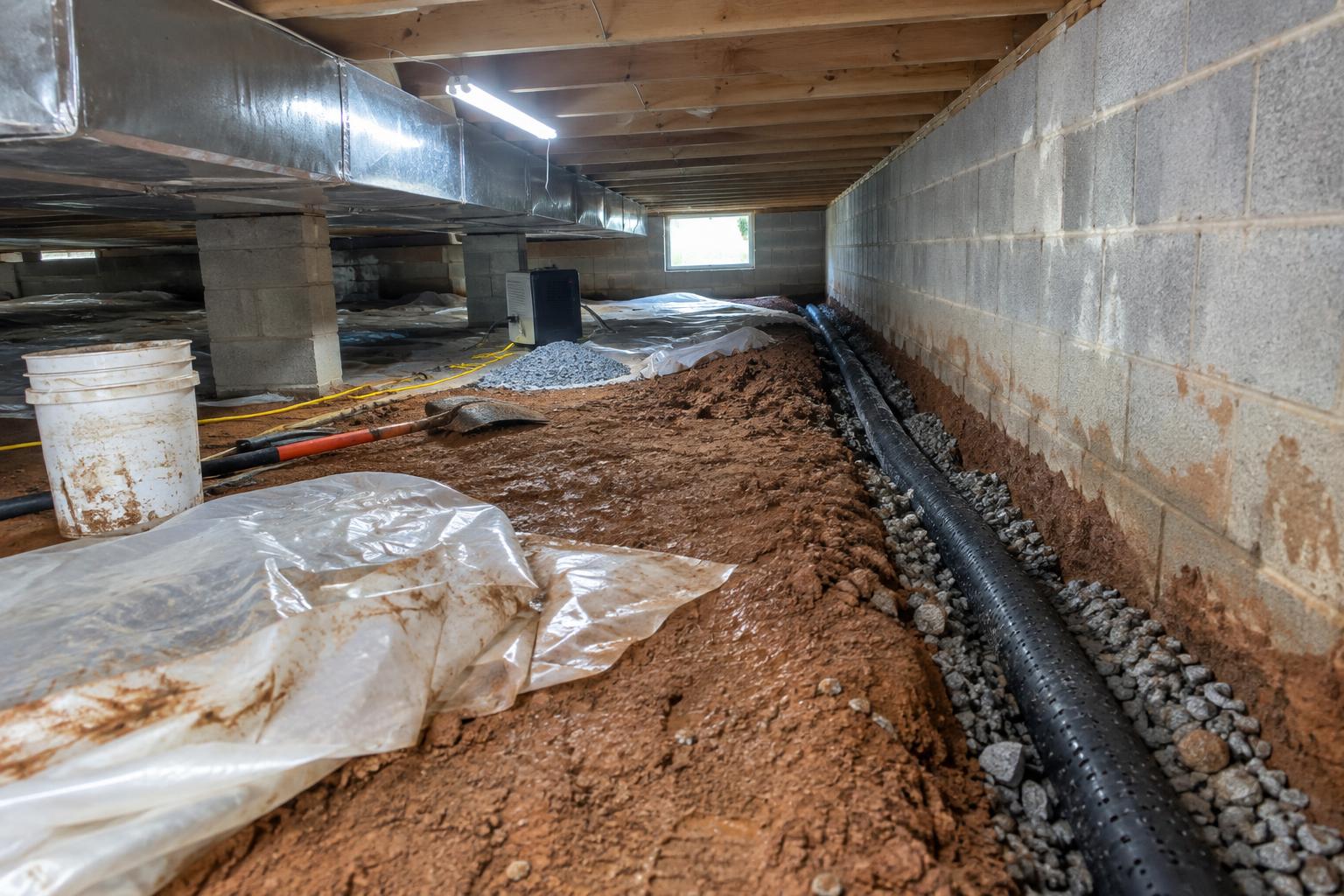
First, we handle the water that is getting in. Where water enters along a wall or collects at a low point, we dig a shallow trench in the clay along the inside of the foundation. Perforated drain pipe goes into clean gravel, sloped to a sump basin. A sump pump in that basin pushes water out through a discharge line away from the house. On a hillside lot, this interior drain is often what stops the puddles at the uphill wall.
Next comes the vapor barrier. We lay a heavy, reinforced liner over the entire dirt floor, run it up the walls and wrap it around the piers. Seams are overlapped and taped so ground moisture cannot rise through the gaps. It is a big step up from the thin plastic many homes started with.
Then we close the space off from outside air. Foundation vents get sealed, and the access door is fitted to close tight. Once the crawl space is sealed, a dehumidifier sized for the space keeps humidity in a healthy range and drains into the sump or a condensate line. That is what stops the summer sweating on ducts and pipes.
Each step is planned around the slope, the soil and where the water actually shows up. You can read more about our approach to crawl space waterproofing in Hardin Valley on our service page.
When the wood has already been damaged
Water left alone for several summers does damage a liner will not reverse. Joists that have softened or cracked, sills with rot and floors that have started to dip all need attention before or during the waterproofing job. In those cases we reinforce or replace the affected wood and add support where the framing has sagged. Our Crawl Space Repair work covers that side of things, and we tie it into the same project so the dry space and the sound structure are finished together.
Mold on framing gets treated as part of the job too. Keeping the space dry afterward is what keeps it from returning.
A few things to check this month
A flashlight and ten minutes at the access door will tell you plenty.
1. Look at the ground after a heavy rain. Shiny mud, puddles or a waterline on the walls mean water is getting in. 2. Check the plastic. Torn, bunched up or holding water, it is doing more harm than good. 3. Shine the light on the insulation. Batts that hang loose or sit on the dirt are usually wet. 4. Smell the air. A strong earthy or musty odor points to mold or long-term dampness. 5. Walk the floors upstairs. New squeaks, soft spots or a slope you did not notice before are worth a closer look.
Outside, make sure downspouts empty well away from the foundation and that soil slopes away from the house. Those small fixes cut down how much water reaches the crawl space to begin with.
Getting a crawl space inspection in Hardin Valley
Waterproofit TN focuses on crawl spaces, and we work throughout Knox, Blount, Anderson, Sevier, Union and Campbell counties. We are licensed and insured, and our work comes with a workmanship warranty. An inspection shows us where water enters, how the air moves and whether the framing needs help, so the plan fits your house.
With water coming into your crawl space right now, call us at 865-503-5483, tell us water is coming in, and we will fit you in as early as we can. For everything else, schedule an inspection before the summer humidity settles in.