
What Karns ground and weather do to a crawl space
Karns sits on red clay over karst limestone, and that combination holds water close to a house long after a storm moves on. Clay drains slowly. When it gets saturated, water follows the easiest path, which is often along the outside of a block foundation and into the crawl space below the floor. The limestone underneath has its own seams and channels, so after a heavy rain some lots see water rise from below as well as seep in from the sides.
Then summer arrives. Knox County humidity stays high for months, and a vented crawl space pulls that air in through every foundation vent. When warm, damp air meets cooler dirt and ductwork under the house, it condenses. Wood picks up that moisture a little at a time. Over a few seasons you get damp insulation hanging loose, a musty smell in the hallway, and joists that feel soft when you press a screwdriver into them.
None of this happens overnight. That is what makes it easy to miss.
What we look for when we crawl under a Karns home
An inspection starts at the access door and works toward the back corners. These are the things we note and photograph for you:
- Standing water or wet mud, especially in low corners and along the uphill wall - Old thin plastic sheeting that is torn, bunched up or missing - Fiberglass insulation sagging between joists or lying on the ground - White fuzz or dark spotting on joists, subfloor and sill plates - Joists or beams that dip, crack or have been notched - Damp stains and white mineral crust on block walls and piers - Ductwork that is sweating or disconnected
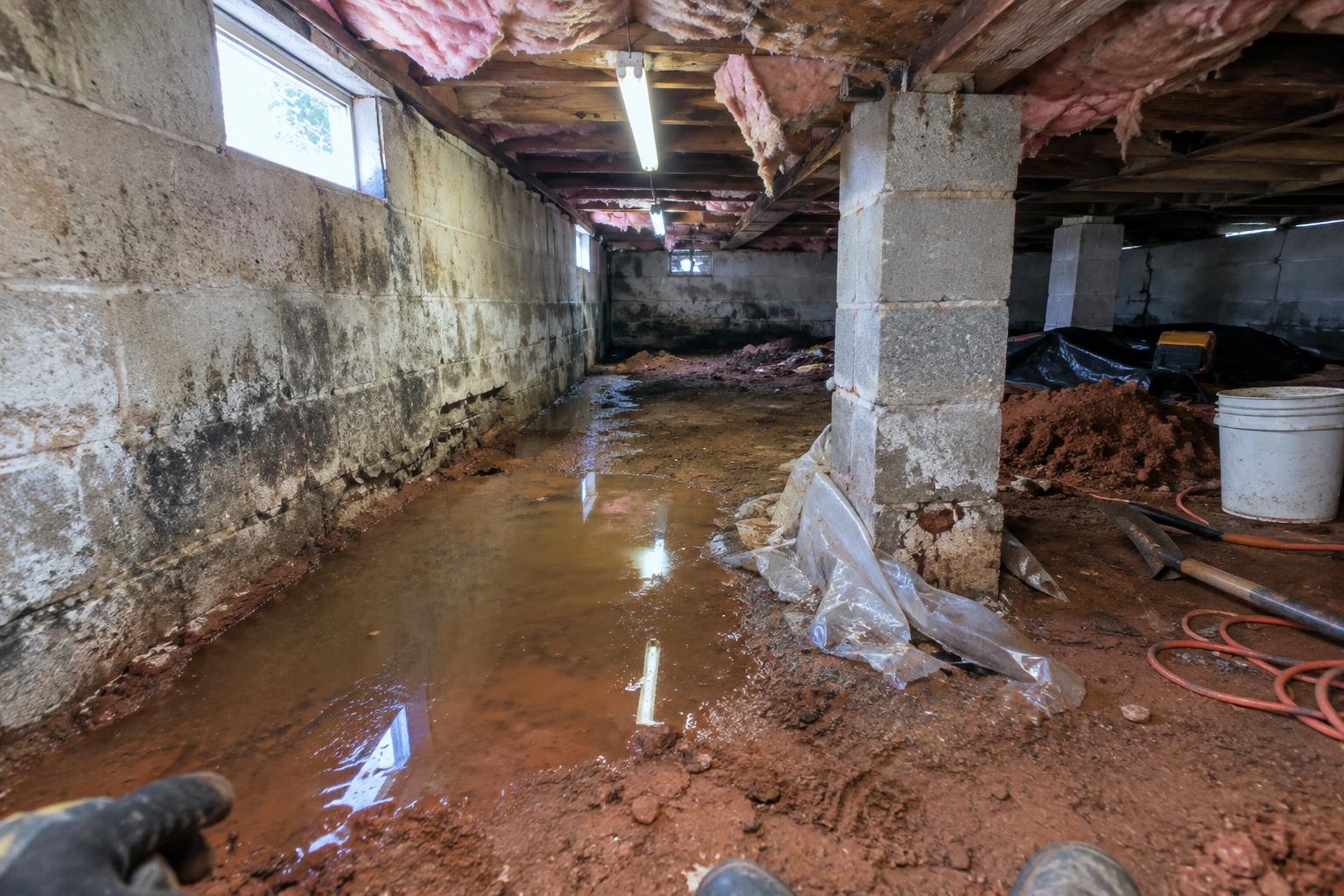
A common scene in older Karns homes: a puddle sitting in the low corner beside a block pier, a strip of old plastic shoved up against it, and soggy insulation drooping overhead. Each piece tells part of the story. The puddle shows where water enters. The plastic shows someone tried to deal with it years ago. The insulation shows how long the air has been wet.
We also walk the outside. Gutters, downspouts and the slope of the yard all affect how much water reaches the foundation wall, so we note those too.
How crawl space waterproofing works
Good crawl space waterproofing in Karns follows the water. The plan depends on what the inspection finds, but most jobs use some combination of these steps.
**Drainage at the low points.** Where water collects, we cut a shallow perimeter drain into the dirt along the inside of the foundation wall, lay perforated pipe in gravel, and slope it toward a sump basin. The pump moves collected water out through a discharge line away from the house. On lots where groundwater pushes up through the limestone, this step does the heavy lifting.
**A heavy vapor barrier.** We pull out the old torn plastic and lay a thick reinforced liner across the floor, up the walls and around each pier. Seams are overlapped and taped. A properly installed barrier stops ground moisture from evaporating into the space and gives you a clean surface you can actually crawl across.
**Sealed vents and openings.** Closing the foundation vents keeps humid summer air from pouring in. We seal the vents, the gaps around plumbing and wiring, and the rim joist where air leaks are common.
**A dehumidifier sized for the space.** Once the crawl space is sealed, a dedicated crawl space dehumidifier holds humidity at a steady level year round. It drains into the sump or a condensate line, so there is nothing to empty.
Some homes need all four. Some need two. We explain what we found and why each step is on the list.
When the wood has already taken damage
Moisture that has worked on a crawl space for years usually leaves marks on the framing. Mold on joists should be treated before the space is sealed. Joists that have softened or sagged need support. Sill plates with rot along the top of the wall need attention.
That is where Crawl Space Repair comes in. We can set support jacks under sagging beams, sister new lumber alongside weakened joists, and replace damaged sections of sill. Doing this alongside the waterproofing makes sense, since the space is already open and cleared. A kitchen floor that bounced underfoot often feels solid again once the framing below is dry and supported.
What to expect after the work
The first change most homeowners mention is the smell. A musty odor that drifted up through floor registers tends to fade over the following weeks. Floors feel less clammy in July, and the air in the house feels fresher.
Upkeep is light. Check that the sump pump cycles after a heavy rain. Glance at the dehumidifier display now and then. Keep gutters clear so roof water lands away from the foundation. Once a year, open the access door and look for anything that has changed.
We are licensed and insured, and our work is backed by a workmanship warranty. If water ever shows up again in a space we have sealed, call us and we will come look.
Getting started in Karns
Most crawl space problems in Karns grow slowly, so the right time to look is before the joists start to dip. Schedule an inspection and we will go under the house, photograph what we see, and walk you through a plan in plain terms. If water is coming in right now, call 865-503-5483, tell us water is entering the crawl space, and we will fit you in as early as we can.