
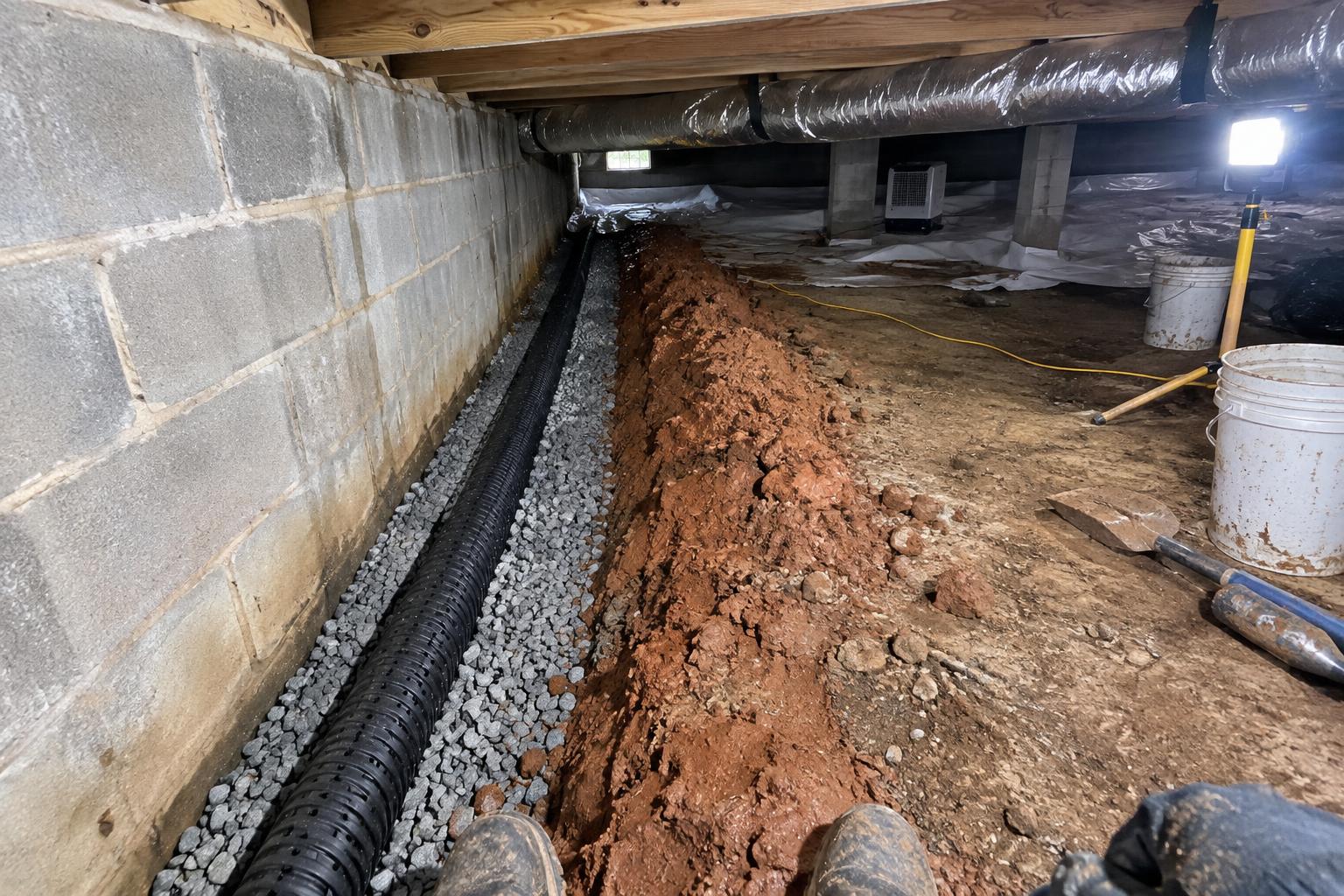
On a first look under a Knoxville house, our crew usually finds the same set of conditions: red clay that stays damp well into late summer, a low corner where water collects after a hard rain, open foundation vents pulling in muggy air, and floor joists with a gray or white bloom along their undersides. Sometimes a torn sheet of thin plastic has been lying on the dirt since the house was built. The homeowner upstairs often noticed a musty smell, or floors that feel soft near the kitchen, long before anyone crawled under.
That pattern repeats across Knox, Blount, Anderson, Sevier, Union and Campbell counties. The details shift from house to house. The causes are local and predictable, which means the fix can be planned around them.
What the ground around Knoxville does to a crawl space
East Tennessee clay holds water. After a storm it drains slowly, so moisture sits against the footings and wicks up through the dirt floor for days. Plenty of Knoxville homes sit on sloped lots. On those, runoff from the uphill side travels along the clay layer and pushes into the crawl space at the lowest wall.
Under the clay is karst limestone. It is full of cracks and channels, and groundwater can rise quickly in wet seasons. Homes near creeks or in low spots tend to see water come up from below as well as in from the sides.
Then there is the air. Summers here are hot and humid. Vented crawl spaces were built on the idea that outside air would dry things out. In practice, warm July air drifts into a cool crawl space, the moisture condenses on ductwork and wood, and the space ends up wetter. Mold follows, and wood that stays damp month after month starts to soften.
How crawl space waterproofing works, step by step
Good crawl space waterproofing in Knoxville starts with figuring out where the water actually comes from. We look at the grade outside, where downspouts empty, staining on the block walls, and which corner holds puddles. We check the wood with a moisture meter and note any sagging or rot.
From there, the work usually follows this order:
1. **Interior drainage.** We dig a shallow trench along the inside of the foundation wall where water enters, lay perforated drain pipe in clean gravel, and slope it toward a collection point. The red clay we dig out gets hauled away or spread level. 2. **Sump pit and pump.** The drain line feeds a sealed sump basin. A pump moves the water out through a discharge line with a check valve and sends it away from the house. 3. **Vapor barrier.** A heavy reinforced liner covers the dirt floor, runs up the walls and wraps the piers. Seams overlap and get taped so ground moisture stays under the liner. 4. **Vents and openings.** We seal foundation vents and gaps so humid outside air stops feeding the space. 5. **Dehumidifier.** A crawl space dehumidifier holds the air at a steady, dry level through the muggy months.
Some houses need only part of that list. A crawl space with no standing water but heavy condensation may only need the liner, sealed vents and a dehumidifier. A house on a hillside with water running in after every storm needs the drainage and pump first, because a liner laid over flowing water just turns into a waterbed.
When the wood has already taken damage
Years of moisture leave marks. We often find joists that sag between piers, sill plates that give under a screwdriver, and subfloor stained dark under bathrooms. Waterproofing stops the cause, and the damaged framing still has to be dealt with.
That is where Crawl Space Repair comes in. Depending on what we find, that can mean sistering new lumber alongside weakened joists, replacing rotted sections, or adding adjustable supports under a sagging beam. We usually handle the structure first and the liner after, so the finished space is dry and solid at the same time.
Mold on wood is common here. We treat affected surfaces as part of the job, and once the humidity stays down, it has little to feed on.
What to do when water is coming in now
Heavy spring storms and long rainy stretches in fall bring the most calls. If you open the crawl space hatch and see standing water, call us and tell us water is coming in. We fit you in as early as we can, find where it is entering, and lay out what it will take to stop it.
In the meantime, a few things help:
- Keep electrical cords and stored items off the wet floor. - Check that downspouts are attached and pointing away from the foundation. - Stay out of deep water near wiring or the furnace. - Take photos of the water level so we can see how high it got.
What to check before you hire anyone
Ask what the crew found and why. A useful inspection explains the water source in plain terms: runoff from the uphill side, ground moisture, condensation, or a mix. If a proposal jumps straight to a dehumidifier without looking at drainage, ask the reason.
Ask what materials go in. Liner thickness, how seams are sealed, where the sump discharges and what size dehumidifier fits your square footage are all fair questions.
Ask about the warranty. Waterproofit TN is licensed and insured, and we back our work with a workmanship warranty. Get the terms in writing from whoever you hire.
Finally, ask to see photos of your own crawl space. Most homeowners never go down there. Seeing the puddles, the bloom on the joists and the open vents makes it much easier to decide what is worth doing now and what can wait.
Call 865-503-5483 to schedule a crawl space inspection anywhere around Knoxville.